It’s always a good idea to try out new sports. In the last 6 months or so, I picked up two new hobbies. The first is padel, which is not so surprising given its enormous popularity, and the second one is, drumroll please…, bouldering! I will likely write another post regarding padel soon, but today we will discuss my bouldering experience so far.
In case you don’t know what bouldering is, borrowing Wikipedia’s definition: bouldering is a form of rock climbing that is performed on small rock formations or artificial rock walls without the use of ropes or harnesses. In our case, I specifically mean climbing indoors, i.e. in an indoor bouldering gym. The bit about not having ropes may sound scary, but note that bouldering is typically done on climbing walls that are only about 3-4 meters tall, which is not very high.
I started bouldering last October when one of my friends took me bouldering and I instantly knew I’d pick it up as a hobby. I’ve been bouldering 2-3 times a week since then. These days I mostly climb at Boulderhane, which is one of the main climbing gyms in Istanbul. Don’t be shy to hit me up if you want to climb together!
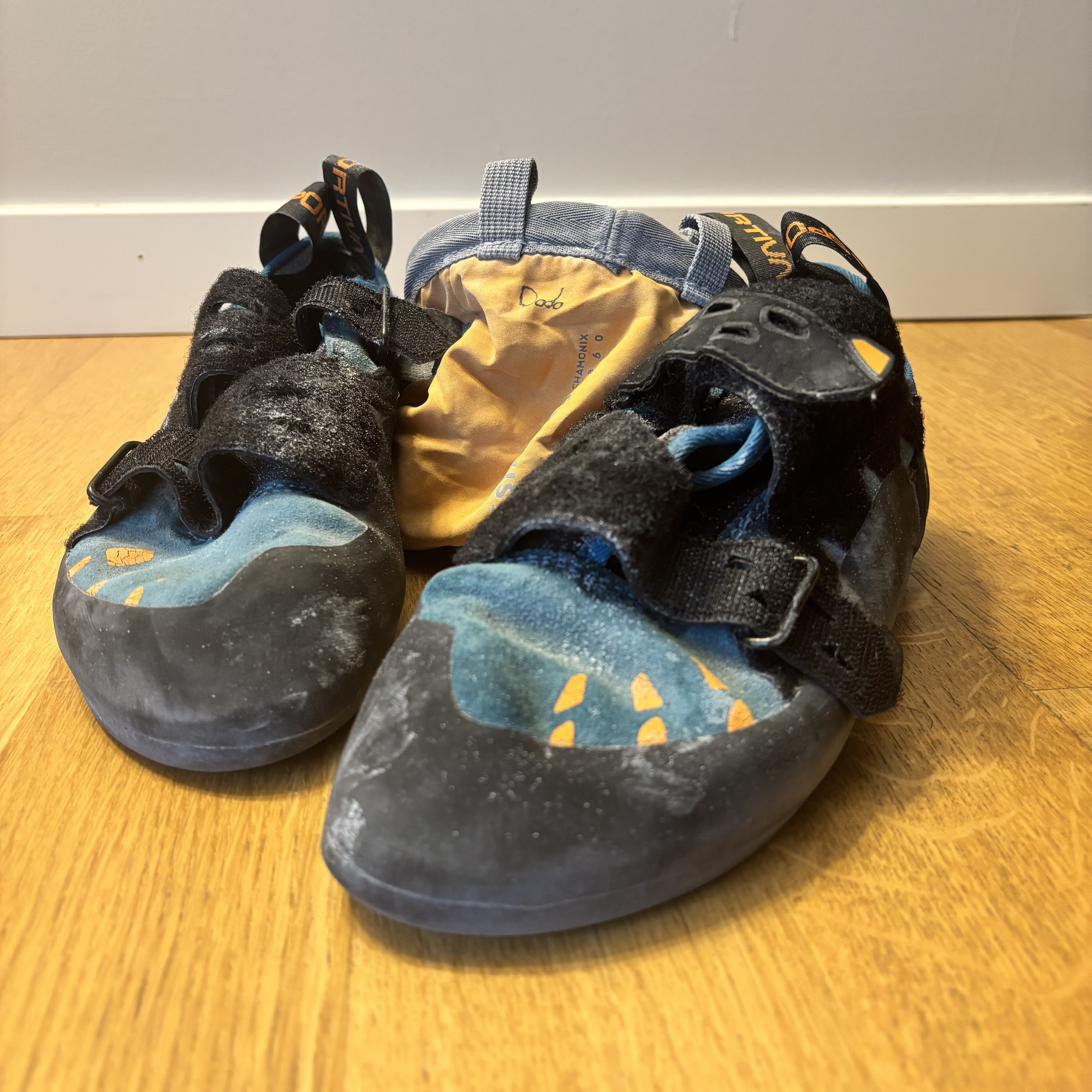
The good, bad, and the ugly
Let’s start with the Instagram reels cliché: “I never thought climbing plastic rocks would be this fun.” I fully agree with this sentiment. Bouldering is a tough but fun sport. It also helps me relax a lot; not sure if it’s because of the mild nerves I feel when I’m somewhat higher than ground level, or the fact that I’m constantly either thinking about a problem or watching someone else tackle a different one, but my brain feels occupied and free. For me, one of the nicest features of bouldering is that, despite being an individual sport, it’s highly social too. I’ve met lots of people while bouldering over the last few months.
There are two aspects of bouldering that I personally dislike: it highly rewards being lightweight, and it places a lot of stress on the fingers, especially the finger pulleys. Bouldering makes you very conscious about your weight and it’s easy to get into the mindset that you should continuously aim to lose weight to get better, which, though partially true, is still less important than skill and strength. Regarding the latter, it’s not surprising that pulley injuries are fairly common among climbers. After all, crimps, and to some extent pockets, can place significant stress on the finger pulleys.
Too tall for climbing?!
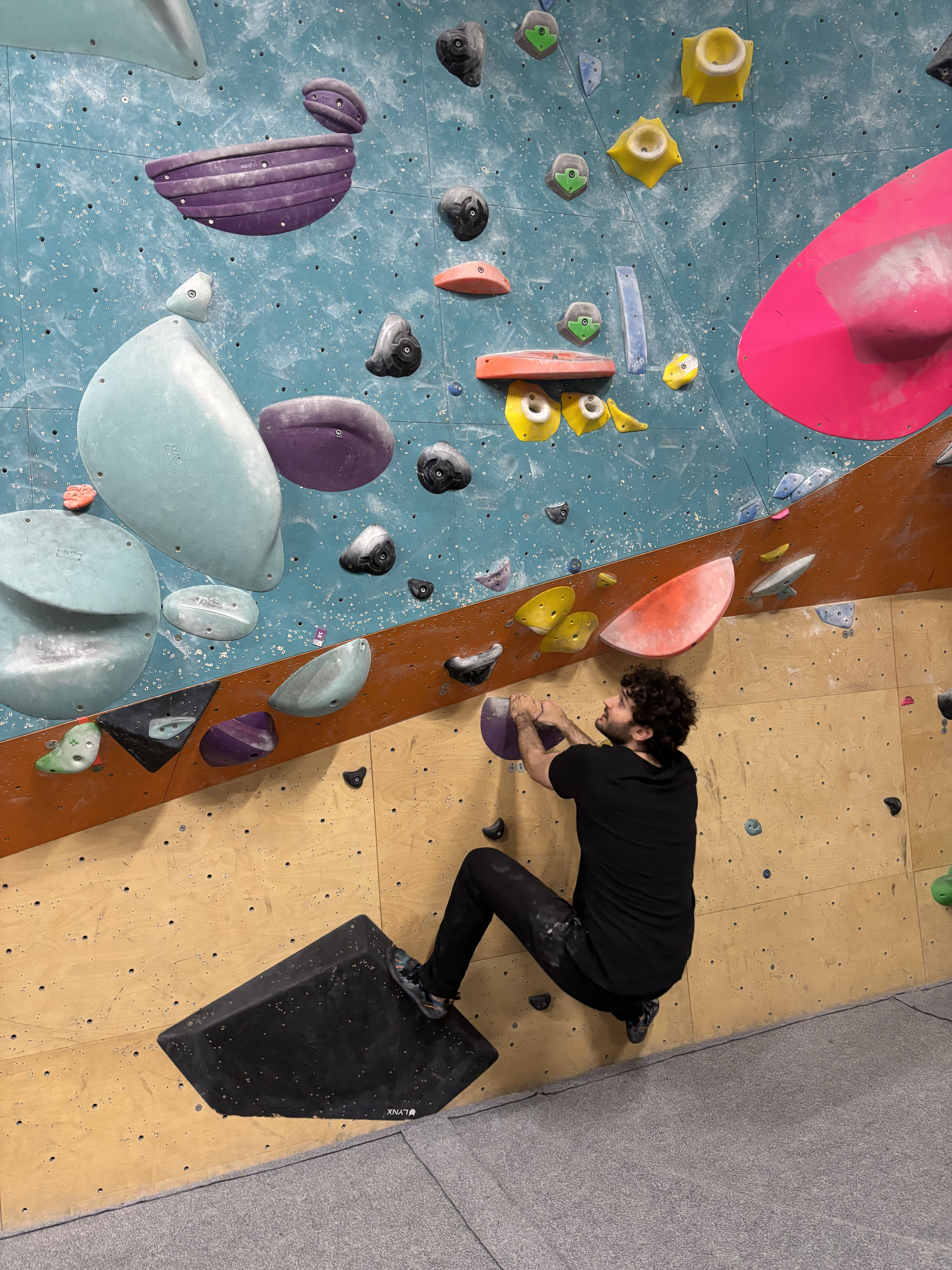
I’m 1.96 m tall. Being a tall climber, I especially hate compressed positions. Regardless of the country or climbing gym, setters seem to enjoy cheesy starts and they rarely seem to consider, perhaps rightfully so, how a genuinely tall climber would begin the route. If you check the heights of elite climbers, it’s easy to observe that most elite climbers are often below 1.90 m. Even climbers who are considered tall, for example Adam Ondra, are really not that tall by, say, basketball’s standards.
When I climb with more experienced climbers, I am often told to stay closer to the wall, even though this is something I already try to pay attention to. I think with taller climbers this is trickier to achieve. Having longer arms and legs means it’s generally harder to bring your hips close to the wall, and you often have to find clever ways to make the movement work. In the process, you end up producing a sort of “tall-person beta”.
On the other hand, obviously, being tall gives you a much longer reach. This is particularly useful for the final moves of certain problems. I often find myself being able to skip certain annoying holds thanks to my height, which seems to annoy my shorter climber friends :)
In short, my experience is that being as tall as I am is a slight disadvantage, yet from a problem-solving perspective I think it makes climbing more fun since I know that I will have to produce a different beta than most people most of the time.
Progress
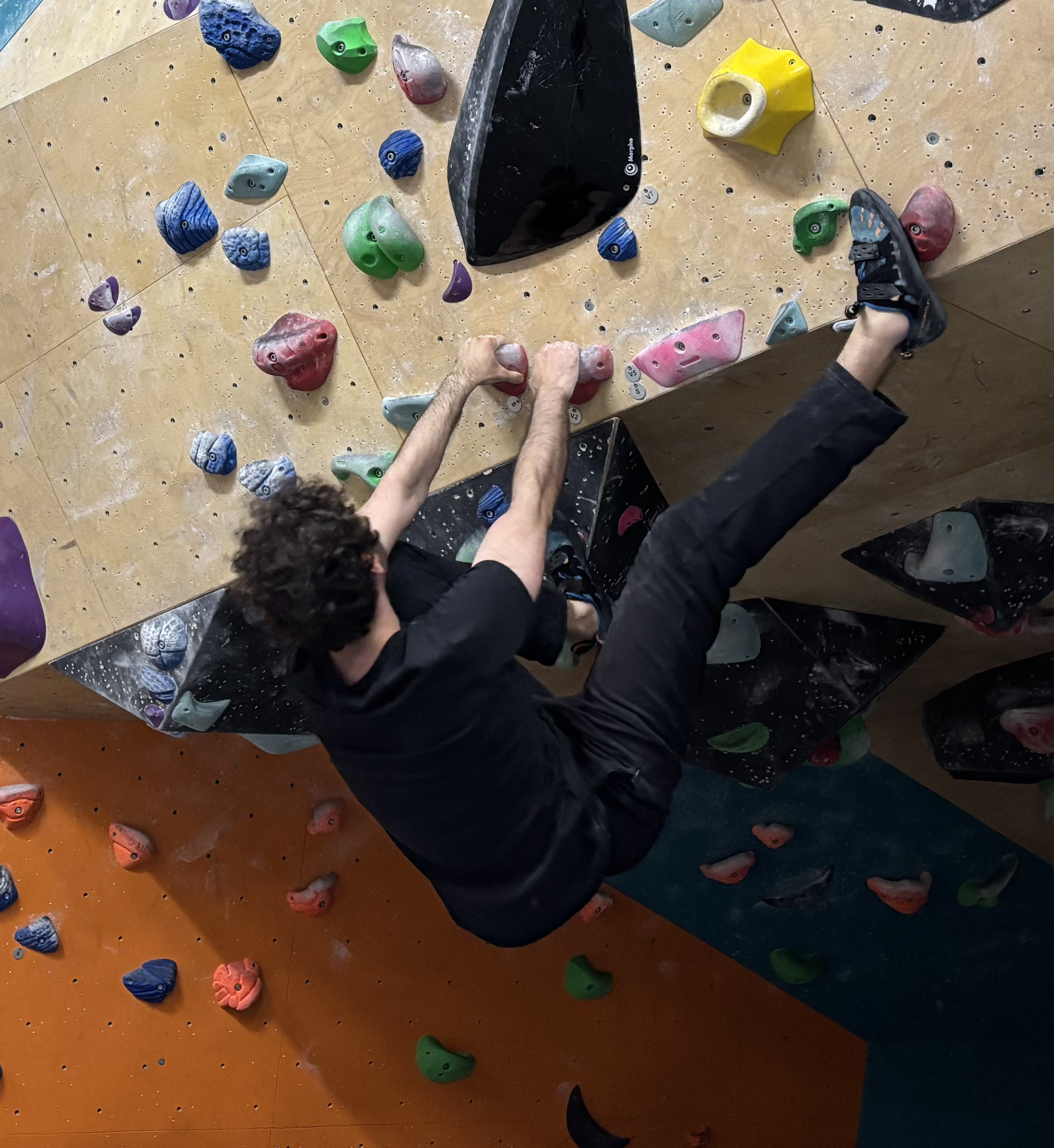
Overall, I’m happy with my progress so far. Having been to bouldering gyms outside of Turkey recently as well, I can confidently say that there is a very high variance amongst the grades assigned to climbs. However, if you were to force me to state a grade, I’d probably say that I’m currently a V3-V4 climber, which on average is the grade of the climbs that I can complete in a few attempts.
Putting the grades aside, I spend more time route-reading now, which I think benefits my climbing a lot. Even if I’m going to attempt a climb right away, the bare minimum has become making sure that I know where all the footholds are, which are often easier to miss, and what type of hold the finishing hold is. I also feel like I retain more of the beta when I watch other people climb routes.
I have not done any serious fingerboarding or board climbing so far, except for the few times I attempted the MoonBoard and realised that I’m not ready. So far, I seem to be progressing consistently, so I didn’t feel the need to adjust my workouts too much. Currently, I climb 3 days a week in the gym and do a mini pull-up workout on two of my free days. The mini-workout I mentioned is simply a 5x5 pull-up workout with 3 minutes rest in between each set.
I also learned when to rest with experience. The main indicators seem to be forearm soreness and mild finger stiffness. But probably the most annoying thing is to come to the climbing gym and realise that I shouldn’t push myself too hard. When that happens, I generally turn the session into a volume session where I attempt to climb as many climbs that are 1-2 levels below my climbing level with as good form as I can. This is of course very frustrating, but I’m fairly sure that even in the short span of my climbing journey it saved me from multiple injuries.
Safety and Injuries
Having played basketball for more than 10 years, I find bouldering to be much safer than playing basketball. The only incident I had so far was the formation of a minor ganglion cyst on my left hand, which may have been related to overuse, but luckily, it went away after 3 weeks of rest.
I tend to avoid difficult slab climbs, especially when the fall feels awkward or the top section looks a bit sketchy. Having both seen people slide off holds and volumes, and experienced it myself, I can confidently say that it is a scary feeling. This is rather unfortunate since slab problems are always extremely fun due to their technical, balance-heavy nature.
The main thing I find scary is that during the busy hours in bouldering gyms there is a higher chance of someone accidentally landing on someone else, which could seriously injure both people. Most gyms do warn excessively regarding this possibility, yet it’s still the thing that worries me the most.
On the other hand, since bouldering is not a contact sport in the traditional sense, the falls are often more controlled than in contact sports, especially if you learn how to fall properly. Also, you get to decide when to give up when the climb feels possibly too dangerous. Of course, if you are the more ambitious type, then as with any sport, bouldering can easily become dangerous.
Future goals for this year
My goals regarding climbing for this year are:
-
to meet, and climb with, more people who also enjoy bouldering
-
to be able to climb 1-2 grades higher than my current grade
-
to learn lead climbing
-
to become strong enough to attempt board climbing
At some point, I also want to try bouldering outdoors, as Turkey has some beautiful regions for this such as Bafa Lake, but this will likely require some self-convincing on my end.
What to watch if you’re curious
If you want to watch some climbing content, some of the YouTube channels that I closely follow are Catalyst Climbing, Erin McNeice, Magnus Midtbø, and Adam Ondra. For competitions, the official World Climbing channel is probably the best place to start. Also, very recently, Janja Garnbret uploaded her first video to YouTube!
As a final tip to anyone who will be climbing for the first time, don’t go too hard on yourself on your first session. You will likely experience some soreness in your hands and forearms in the days to come, so be gentle with yourself. In fact, this can be converted to a more general statement: regardless of which sport you are doing, always listen to your body.